
Three weeks after handing over 14 stalls at PharmaTech Expo in Gandhinagar, our team was on another pharma floor — this time at iPHEX 2026, 7–9 September at Bharat Mandapam, New Delhi, where we delivered eight stalls for India's pharmaceutical export platform.
Before the show, we published a stall planning guide for iPHEX exhibitors arguing that an export show changes what a stall is for. This is the follow-through: what those principles look like built, photographed, and handed over.
The event, briefly
iPHEX — organized by Pharmexcil with the Department of Commerce, Government of India — is where international buyers come to source from Indian pharmaceutical and healthcare companies. Its 12th edition ran three days at Bharat Mandapam. The audience isn't footfall; it's delegations comparing suppliers. Every design decision below follows from that fact.
The project set
| Stalls delivered | 8 |
| Combined floor area | 262 sqm |
| Size range | 24 sqm to 44 sqm |
| Configurations | 2 one-side open · 3 two-side open · 3 three-side open |
| Shared two-brand stalls | 3 of 8 |
| Venue | Bharat Mandapam, New Delhi |
No giants in this set — iPHEX plots run mid-size, which makes discipline the whole game. And one pattern stands out immediately: three of the eight stalls carried two brands each. More on that below, because it's the most requested thing nobody writes about.
What an export-show stall has to say
Walk this delivery and the same three messages repeat, because export buyers ask the same three questions:
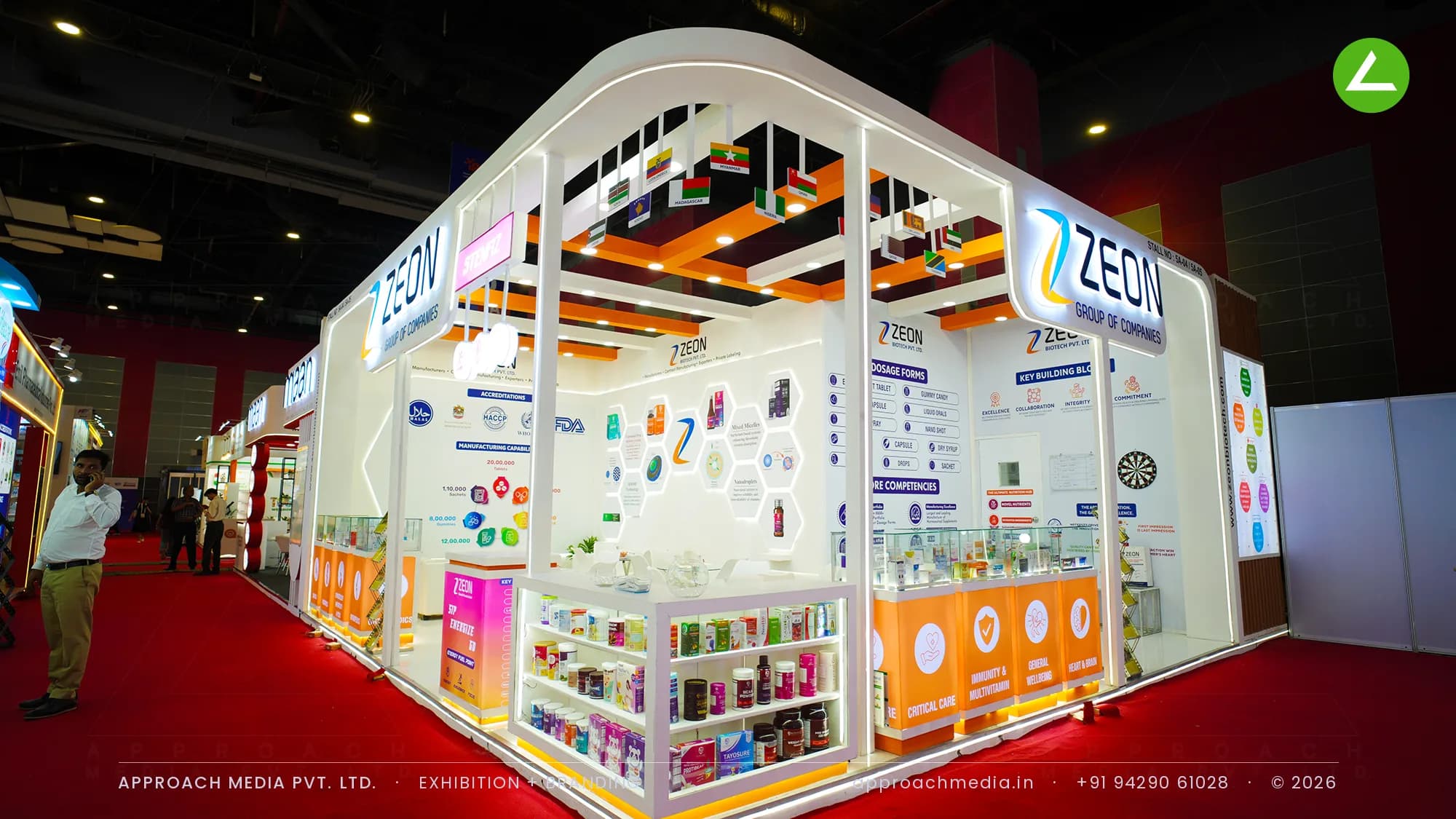
"Where do you already sell?" Nearly every stall in this set answers it visually: country flags hung in Zeon's ceiling grid, an export flags wall at the centre of the Soins–Nexlife stand, backlit flag panels on the Sanolet–Rednex fascia walls. A buyer from Nairobi or Tashkent looks for their region before they look at your products.
"Are you certified for my market?" Accreditation graphics got prime positions — a dedicated credentials panel at Avantika, accreditation walls at Captavis, certification strips across the set. At a domestic show this is supporting material; at iPHEX it's the headline.
"Show me the range." Export buyers shortlist portfolios, so product display carried these stalls: therapy-segment plinths with glass vitrines at Zeon, unbroken three-tier shelving runs at Dev International–Growequal, LED-lipped stepped ledges at Soins. Products presented like a catalogue you can walk through.
The shared stall, done properly
Two companies sharing one stall is common at export shows — it halves cost and doubles presence — but done lazily it just blurs both brands. Three stalls in this set solved it deliberately:
- Sanolet Lifecare + Rednex Pharmaceuticals (36 sqm, 3-side open): a split portal fascia giving each brand its own face — and its own LED edge-line colour — with a shared reception counter serving one brand per side.
- Soins Healthcare + Nexlife Bioscience (24 sqm): a blue-and-white split frontage under one curved header, each brand holding its own section with its own backlit identity.
- Dev International + Growequal (32 sqm, corner): two brand portals over one continuous product wall, letting the range unify what the fascias divide.
The principle in all three: divide the identity, share the infrastructure. Separate faces, colours and signage; common counters, lounges and storage. Each brand reads clearly from its own aisle, and the budget works twice as hard.
The one-side-open problem
Two stalls in this set — Soins–Nexlife and Avantika, both 24 sqm — had the hardest configuration in exhibiting: one open side. Everything must work from a single viewing direction, like a stage. Both solved it the same honest way: full-width backlit presentation walls, product niches lit from within, and the brand story arranged as one composed frontal picture. If your next plot is one-side open, those two project pages are worth studying.
The eight projects
Each entry links to the full project page with complete photo sets.
Zeon Group of Companies — 44 sqm, 2-side open. The set's largest build: a curved white portal with an orange coffer grid hung with country flags, a hexagon feature wall with LED accents, and eight therapy-segment plinths topped with glass vitrines. Zeon Group's 44 sqm iPHEX stall
Salud Care Group of Companies — 42 sqm, 3-side open. Light timber slats, artificial-turf edging and illuminated glass shelving bays around two interior lounges — a warmer, hospitality-toned language on a corner plot. Salud Care's 42 sqm three-side-open stand
Sanolet Lifecare + Rednex Pharmaceuticals — 36 sqm, 3-side open. The two-brand split done with a colour system: each company's fascia face carries its own LED edge line, over glazed vitrines and backlit country-flag panels. The Sanolet–Rednex shared stall
Kavit Soap Industries — 36 sqm, 3-side open. Coral, blush and gold tones with arched niches presenting four care ranges, fluted counters under raking light, and a pink archway lounge with dome pendants — retail warmth at a trade show. Kavit Soap Industries' 36 sqm stall
Dev International + Growequal — 32 sqm, 2-side open corner. Arched white portals for each brand over three maroon-edged shelf tiers running unbroken along both walls, each tier washed in strip light. The Dev International–Growequal corner stall
Soins Healthcare + Nexlife Bioscience — 24 sqm, 1-side open. A blue-and-white split frontage with stepped, LED-lipped product ledges and an export flags wall at centre — two brands composed as one frontal picture. The Soins–Nexlife shared stand
Captavis Biocare — 24 sqm, 2-side open corner. Vertical timber battens under a wave-profile fascia wrapping the corner with a teal trim line; backlit panels separate domestic and export ranges — the export question answered in the layout itself. Captavis Biocare's 24 sqm corner stand
Avantika Medex — 24 sqm, 1-side open. A white panel sweeping into a wood-clad return with cove lighting, hexagonal timber niches lit from within, and a blue credentials panel carrying the certifications front and centre. Avantika's 24 sqm iPHEX stall
What this delivery reinforced
Mid-size is a discipline, not a limitation. At 24–44 sqm, nothing carries dead weight: every wall works as display, every counter doubles as storage, lighting does the theatre. The cost logic we've published shows why disciplined mid-size stalls deliver the strongest value per square metre.
Export shows reward preparation over spectacle. The stalls that stayed busiest presented range, reach and certification legibly — exactly what delegation buyers came to check.
Two shows, three weeks, one workshop. PharmaTech's 14 stalls and iPHEX's 8 came out of the same 30,000 sq ft Ahmedabad facility, every build 100% mock-up tested before dispatch — to Gandhinagar and to Delhi alike. That's the operating model: fabricate and test at home, deliver finished, install inside the venue's window.
Exhibiting at the next export show?
The pharma export calendar rolls on — CPHI & PMEC India runs across two Delhi-NCR venues in November. Send us your exhibition name, city, stall size and floor plan, and you'll have a concept and costing within 48 hours, fixed-price.
About the author
Mehul is a Director at Approach Media Pvt Ltd, an exhibition stall design and fabrication company in Ahmedabad operating since 2002.
Related
- India ITME 2026: Building a Stall for a Six-Day Machinery Marathon
- CPHI & PMEC India 2026: Two Venues, One Pharma Week — Plan Accordingly
- Exhibitor's Guide to Yashobhoomi (IICC), New Delhi
- Windergy India 2026: Stall Planning When Your Product Is 100 Metres Tall
- CPHI Milan 2026: A Stand Guide for Indian Pharma Exporters
- Beautyworld Dubai 2026: A Stand Guide for Indian Beauty & Fragrance Brands
- Anuga FoodTec India 2026: Stall Planning for Food Technology Exhibitors
- Aluminium Bharat 2026: Exhibiting at Gujarat's Aluminium Showcase
- 14 Stalls, One Build Window: How We Delivered at PharmaTech Expo 2026
- REI Expo + The Battery Show India 2026: One Venue, Two Shows, One Plan
- SEMICON India 2026: Stand Planning for a Precision Industry
- bauma CONEXPO INDIA 2026: Stand Planning When Your Exhibit Weighs Tonnes
- Exhibitor's Guide to Helipad Exhibition Centre, Gandhinagar
- Custom vs Modular Exhibition Stands: Which Should Indian Exhibitors Choose?
- Double-Decker & Mezzanine Stall Rules in India: What You Must Clear Before You Build
- How Much Does Exhibition Stall Design & Fabrication Cost in India? (2026 Rates)
- What Drives Exhibition Stand Cost in Dubai? A Guide for Indian Exhibitors
- Exhibition stand builders in Ahmedabad
- Exhibition stall designer in Delhi
- The full Approach Media portfolio